

Kathmandu-
The Government of Nepal, in partnership with the Government of China and the Food and Agriculture Organization of the United Nations (FAO), has launched the “Strengthening Agrifood Systems in Nepal (GCP/NEP/094/CPR)” project to promote climate-resilient agriculture, improve rural livelihoods, and strengthen food and nutrition security in Nepal’s hill and mountain regions.
The 24-month project, financed through the Government of China’s Global Development and South-South Cooperation Fund, was launched at the request of the Government of Nepal. It aims to strengthen local institutions, promote climate-smart agriculture, improve nutrition, encourage environmental sustainability, support digital innovation, and foster inclusive rural development.
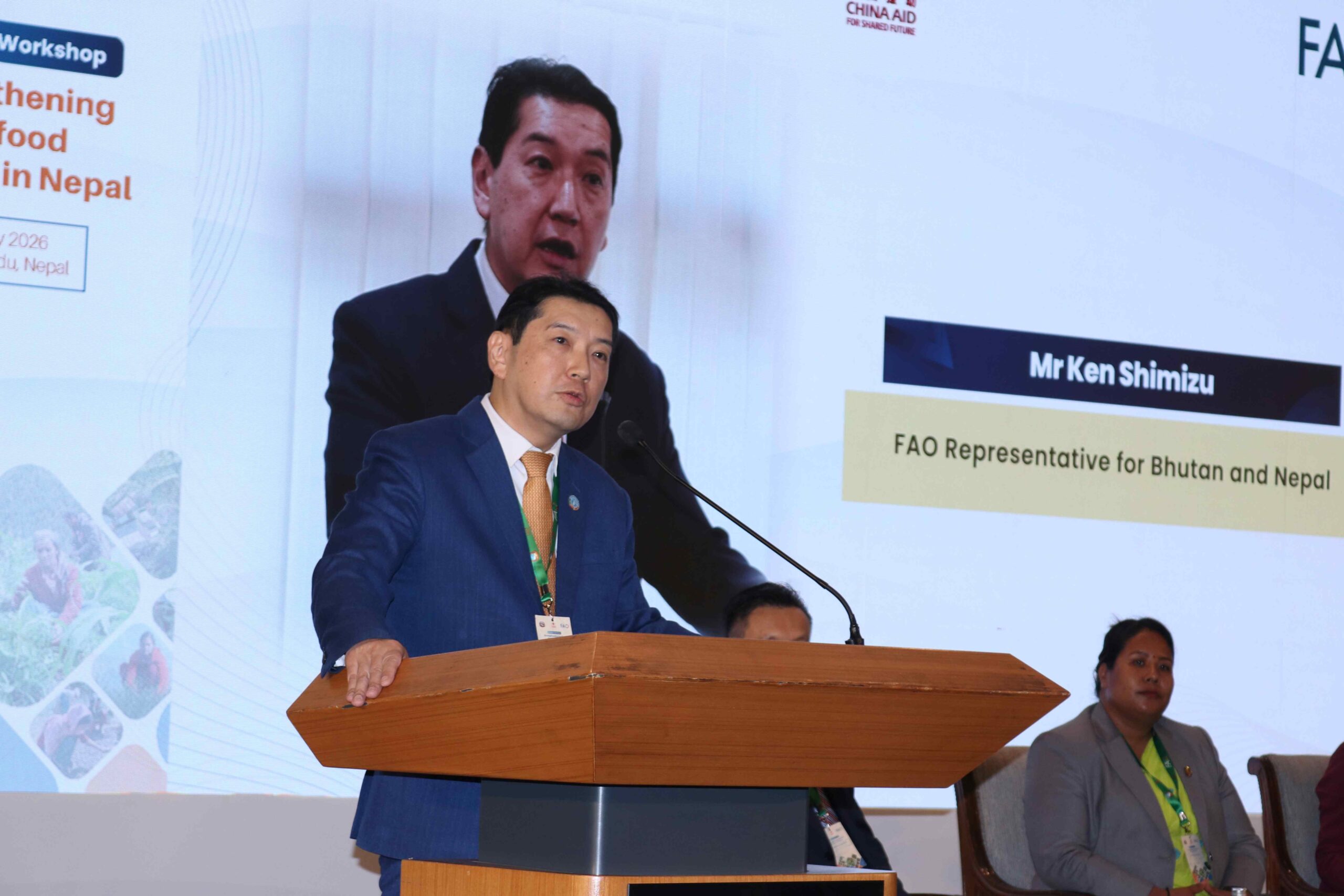
The launch ceremony was attended by Minister for Agriculture, Forests and Environment Gita Chaudhary, Chinese Ambassador to Nepal Zhang Maoming, FAO Director of the South-South and Triangular Cooperation Division Hua Yang, FAO Representative for Bhutan and Nepal Ken Shimizu, senior government officials, provincial and local government representatives, development partners, farmer organizations, and other stakeholders.
Addressing the programme, Minister Chaudhary said the project would contribute to climate-smart agriculture, improved food and nutrition security, expanded market access, and stronger local institutional capacity. She said the initiative would help build a more resilient and sustainable agrifood system while supporting Nepal’s national goals of food security, rural prosperity, and sustainable development.
Speaking on the occasion, Chinese Ambassador Zhang reaffirmed China’s commitment to supporting Nepal’s agricultural transformation through South-South Cooperation, technology transfer, capacity building, and knowledge exchange. He expressed confidence that the project would strengthen agricultural productivity, enhance resilience, improve food security, and contribute to Nepal’s agricultural modernization and the achievement of the Sustainable Development Goals (SDGs).
FAO’s Hua Yang highlighted the organization’s vision of the “Four Betters”—better production, better nutrition, a better environment, and a better life—and stressed the importance of strong national ownership and international partnerships in transforming agrifood systems. She expressed hope that the initiative would become a model for South-South Cooperation in Asia and beyond.
FAO Representative Ken Shimizu said the project reflects the shared commitment of Nepal, China, and FAO to promoting resilient, inclusive, and sustainable agrifood systems through partnership, innovation, and locally driven solutions.
According to FAO, Nepal’s agriculture sector continues to face major challenges, including climate change, declining productivity, labour shortages caused by youth migration, limited market access, and increasing pressure on local governments to deliver agricultural services. These issues are particularly severe in hill and mountain areas due to geographical isolation, weak infrastructure, and limited livelihood opportunities.
The project seeks to address these challenges by strengthening the capacities of municipalities, cooperatives, farmer groups, extension service providers, and local institutions. It will support improved agrifood planning, climate-resilient farming, governance, financial management, agribusiness development, market linkages, and social inclusion.
Implementation will focus on Mandandeupur and Panchkhal municipalities in Kavrepalanchok district and Rong Rural Municipality and Ilam Municipality in Ilam district. Activities will include measures to increase agricultural productivity, diversify livelihoods, improve food and nutrition security, strengthen community resilience, enhance access to safe drinking water, improve natural resource management, and promote greater participation of women, youth, and marginalized communities.
A key component of the initiative is the expansion of digital agricultural extension services. Through digital platforms, farmers will gain access to technical advice, weather forecasts, financial services, agricultural insurance, and market information, helping reduce climate-related risks and improve decision-making.
The project also promotes South-South and Triangular Cooperation by facilitating technical knowledge exchange and development cooperation. Officials said the partnership demonstrates the shared commitment of Nepal, China, and FAO to advancing resilient, inclusive, and sustainable agricultural development.
During the programme, Joint Secretary at the Ministry of Agriculture, Forests and Environment Dr. Hari Bahadur K.C. presented an overview of the project, highlighting its focus on improving agricultural production, strengthening local systems, and creating better livelihood opportunities for rural communities.
The initiative is aligned with Nepal’s national priorities on food security, climate adaptation, local governance, rural development, and sustainable natural resource management, while contributing to the achievement of the Sustainable Development Goals. Through the project, Nepal, China, and FAO reaffirmed their commitment to strengthening local capacities, promoting innovation, and supporting resilient rural livelihoods across vulnerable hill and mountain regions.


