

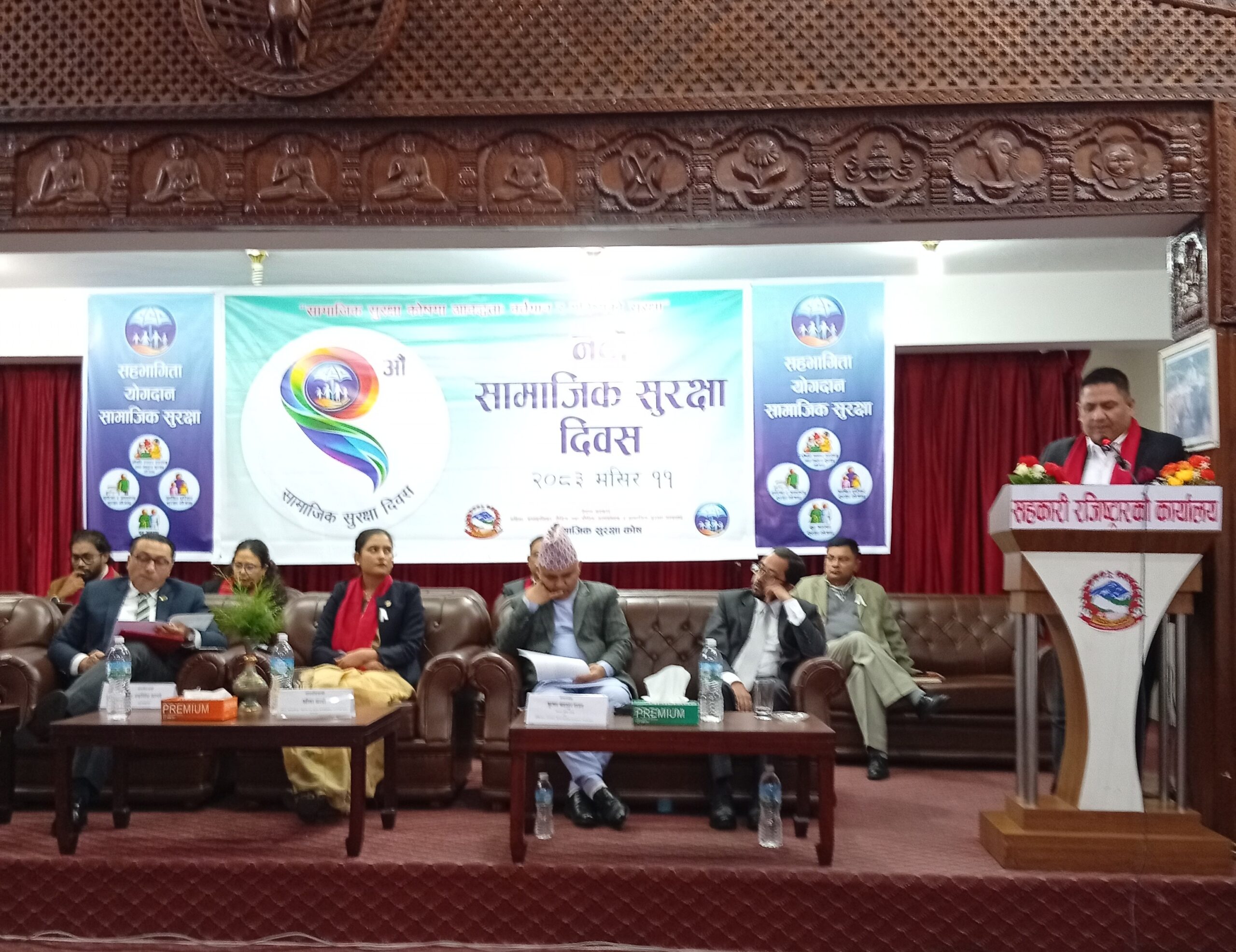
Kathmandu. Prabal Jung Pandey, Vice President of the Federation of Nepalese Chambers of Commerce and Industry (FNCCI) and Chairperson of its Employer Council, has urged the government to review the provisions related to wages and social security contributions for workers engaged in public procurement.
Speaking at an event organized on the occasion of the ninth Social Security Day, Pandey called for the removal of disparities in contributions made by employers and workers to the Social Security Fund and urged the government to make the social security system more practical and effective.
He said social security is a matter linked to workers’ rights and employers’ responsibilities, and that changes in the ministry’s name or institutional structure should not weaken the government’s responsibility toward workers’ social security.
Pandey said some provisions of the recently issued ‘Procedure on Wages and Social Security of Workers Engaged in Public Procurement, 2083’ were positive but had created additional challenges for the private sector and construction businesses.
“While the minimum wage in the private sector is Rs 19,550 per month, or Rs 754 per day, the daily wage for unskilled workers engaged in public procurement has been fixed at Rs 1,740. A two-tier wage system in the same labor market could lead to workers leaving the private sector, increase industrial costs and weaken competitiveness,” he said.
Pandey also said businesses could face an additional financial burden if the new wage rates and 10 percent contribution were applied immediately to existing contracts whose rates, cost estimates and bidding documents did not include the revised provisions.
He stressed the need for adequate discussion and consultation with employers, workers and other stakeholders before implementing the new provisions.
Pandey further said billions of rupees had already been accumulated in the Social Security Fund and argued that the money should not simply remain deposited in banks. Instead, he called for investment in productive sectors such as infrastructure, hydropower, industries and employment-generating activities.