

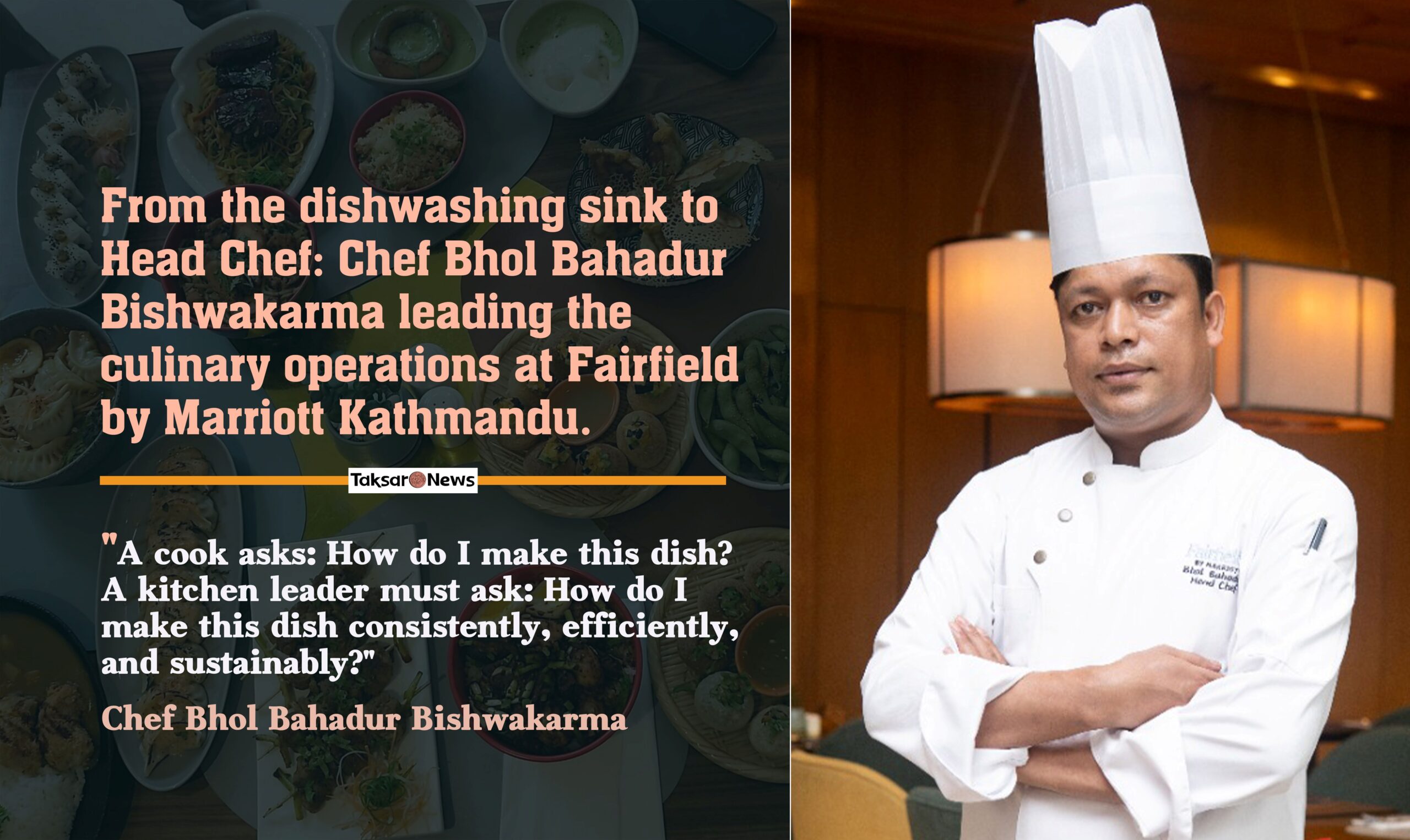
By Editorial Desk
The first lesson Chef Bhol Bahadur Bishwakarma learned in a professional kitchen was not about cooking.
It was about cleaning.
Long before he wore a chef’s coat and took charge of a hotel kitchen in Kathmandu, he stood at a sink washing dishes. There were no elaborate menus to design, no team waiting for his instructions, and no guests expecting a carefully plated meal from him.
There was simply work. And he learned to respect it.
That humble beginning now seems distant from his present position as Head Chef at Fairfield by Marriott Kathmandu Thamel. The hotel recently welcomed him into the role, describing his appointment in terms of culinary excellence, creativity, and leadership.
But for Bishwakarma, the distance between the sink and the chef’s table is not a story of overnight success. It is a record of thousands of ordinary working days—of learning one station at a time, surviving the pressure of professional kitchens, moving between countries and international hotel brands, mastering Indian and global cuisines, and gradually understanding that being a chef is about much more than cooking.
It is about people.
It is about systems.
It is about consistency.
And increasingly, for Bishwakarma, it is about identity—about how a country like Nepal can tell its story through food.
A Village, a Long Road, and a Kitchen Sink
Bishwakarma was born in Likuwa Pokhari, Khotang, in eastern Nepal.
His early life was far removed from the world of luxury hospitality. Growing up in a rural environment where daily life demanded physical effort, patience, and resilience, he spent his youth working in the fields and traveling long distances to access basic supplies. Those hard-won experiences shaped his attitude long before he entered the hospitality industry.

When he eventually entered professional hospitality, he did not walk through the front door of a prestigious hotel as a trained chef. He started by washing dishes.
For some, dishwashing might have been a job to escape as quickly as possible. For Bishwakarma, it became a classroom.
A dishwashing station is not where guests see the hotel, but it is where the discipline of a professional kitchen begins. Cleanliness has to be absolute. Work has to be organized. Timing matters—a single delayed task ripples through the entire line. During busy service, the kitchen operates like a machine, with dozens of people performing synchronized roles under immense pressure.
From that vantage point at the sink, Bishwakarma began to understand the architecture of a kitchen. He watched. He learned. He moved closer to the line—and eventually, he found himself working with fire.
Learning From the Tandoor
The tandoor became an important cornerstone of his early culinary development.
Tandoor cooking is deceptively simple: fire, food, and time. Yet mastering it requires extreme discipline over heat, marination, texture, and precision. A few extra minutes can destroy a dish; too little heat leaves it underdeveloped. The cook must learn to read the fire as closely as the food.
His career progressed step-by-step through the traditional professional hierarchy: Commis, Demi Chef de Partie, Chef de Partie, Junior Sous Chef, Sous Chef, Chef de Cuisine, and eventually, Head Chef.
Each position transformed the nature of his responsibility. As a junior, the priority was learning. Then came responsibility for a specific station. Later, managing people and workflow. Eventually, he had to master budgets, food costs, inventory, menu design, hygiene compliance, and overall team performance.
The transition was significant:
- A cook asks: How do I make this dish?
- A kitchen leader asks: How do I make this dish consistently, efficiently, and sustainably—and build a team capable of doing it every single day?

India as a Culinary Classroom
Some of Bishwakarma’s most vital lessons came from his years in India. His career path spanned major international properties, including The Westin Gurgaon, Sheraton Hyderabad, and The Den Bengaluru, before he returned to Nepal to work with Kathmandu Marriott Hotel, Hyatt Centric Soalteemode, and now Fairfield by Marriott Kathmandu.
India offered something no single cookbook could provide: immersion in an enormous diversity of regional culinary traditions. Awadhi gastronomy differs fundamentally from Hyderabadi cooking; Punjabi tandoor traditions carry a different rhythm than Rajasthani or South Indian cuisines.
Working within this diversity reinforced a central realization: food is inseparable from place.
- A recipe is shaped by geography.
- Ingredients are shaped by agriculture.
- Techniques are shaped by history.
- Taste is shaped by generations.
That understanding would later become foundational when he began examining Nepal’s own culinary repertoire.

The Chef Who Manages More Than a Menu
The romantic image of a chef is someone standing over a pan, tasting a sauce, and placing a final garnish on a plate. The reality of professional hospitality is far more operational.
A hotel kitchen is a complex logistical machine involving procurement schedules, food cost variance, inventory control, staffing rosters, food safety standards, banquet execution, and last-minute dietary adjustments. Bishwakarma’s expertise spans these operational pillars—from pre-opening setups and Standard Operating Procedure (SOP) development to high-volume event production and menu engineering.
This is where culinary skill turns into management. A chef may create a brilliant dish once, but a hotel requires that dish to be reproduced hundreds of times without losing its character. Consistency becomes a form of excellence—and consistency cannot be achieved through talent alone. It requires systems.

What the Sink Taught the Chef
Perhaps the most defining aspect of Bishwakarma’s leadership is that he remembers where he started.
He has worked the sink, the tandoor, and the line. He has followed instructions as a junior and now delivers them as a leader. That perspective gives him a unique view of kitchen hierarchy.
For him, a kitchen is not a collection of titles; it is an interconnected team where every role impacts the guest’s final experience.
- The person washing dishes matters.
- The person prepping ingredients matters.
- The person working the hot line matters.
- The person plating matters.
And the person leading the kitchen must understand how all those roles connect.

Elevating Nepali Ingredients
Beyond managing international hotel standards, Bishwakarma’s focus has increasingly turned toward Nepal’s native culinary assets.
Nepal possesses unique ingredients capable of giving its cuisine a distinct global identity: Timur (Himalayan pepper), Jimbu (Himalayan aromatic herb), Gundruk and Sinki (fermented leafy greens and root vegetables), Lapsi (hog plum), Kodo (finger millet), Phapar (buckwheat), wild Himalayan mushrooms, and mountain yak cheese.
To Nepali households, these are everyday staples. To an international diner, they represent an introduction to the country itself.
Consider timur: it offers a signature tingling sensation and citrusy aroma that sets it apart from standard peppercorns. Jimbu, when tempered in clarified butter (ghee), imparts an unmistakable earthy depth. Gundruk tells a story of mountain preservation and fermentation.
The challenge lies in presenting these ingredients with context, technique, and consistency—moving beyond local comfort food to refined global experiences without losing their cultural soul.
Beyond Momo: Redefining Nepal’s Food Story
Nepal’s international culinary identity has long been compressed into a few familiar highlights—primarily Momo and Dal Bhat. Yet Nepal’s true food heritage is vast, varied by geography, community, and climate. The historical concept of Chaurasi Byanjan—an elaborate feast of 84 distinct dishes—reflects the true depth of the culture.
The pressing task now is documentation and modern interpretation. Many traditional recipes survive only through oral practice and household memory. Without formal documentation, standardization, and professional integration, there is a risk that traditional foodways could fade.
Bishwakarma has also explored cross-cultural culinary dialogue—pairing Nepali ingredients with global techniques, such as incorporating gundruk into savory broths reminiscent of dashi, or refining traditional dumpling folding and searing techniques. When rooted in respect, such culinary dialogue allows local flavors to reach new audiences.

From Khotang to Thamel
There is something quietly remarkable about the arc of Bishwakarma’s journey.
It began in Likuwa Pokhari, Khotang, passed through high-volume kitchens across India, and led to Thamel—the vibrant heart of Kathmandu’s international tourism district—where he leads the culinary operations at Fairfield by Marriott Kathmandu Thamel (home to its signature restaurant, Kava).
The physical distance from rural Khotang to Thamel is substantial; the professional distance is vast. Yet the link between them remains food.
Chef Bhol Bahadur Bishwakarma’s story is not one of sudden luck, but of steady accumulation: one shift, one station, one kitchen at a time. Having mastered international hotel standards, he is now channeling that experience back into the flavors of home—proving that where you start does not limit how far you can go.

Branding Nepali Cuisine on the Global Stage
Today, Chef Bhol Bahadur Bishwakarma is on a mission to put Nepali gastronomy firmly on the global culinary map. He believes that food is one of the most powerful storytelling mediums available for tourism, capable of capturing the spirit, geography, and heritage of a nation in a single bite. By bringing authentic local ingredients into high-end hospitality standards, he is turning everyday Nepali meals into exquisite cultural experiences that linger in the memories of international travelers long after they leave the country.
Looking toward the future, Bishwakarma envisions taking this movement far beyond the borders of Nepal. His ambition is to travel worldwide as a culinary ambassador, promoting Nepali flavors across international food festivals, hotel pop-ups, and global gastronomy forums. By introducing global audiences to indigenous ingredients like timur, jimbu, and mountain herbs through modern cooking techniques, he aims to elevate Nepal’s image from solely an adventure destination to a world-class culinary hotspot.
Ultimately, his campaign to brand Nepali food globally is an economic and cultural strategic vision. By generating global interest in authentic dishes, he hopes to boost Nepal’s tourism economy, empower local farmers who cultivate native crops, and inspire the next generation of Nepali chefs. Through his dedication, passion, and years of hard-won expertise, Bishwakarma is proving that Nepal’s culinary identity is ready to take center stage across the globe.