

On August 26, 2026, a catastrophic high-Himalayan event sent a devastating flood through the Bhotekoshi-Trishuli corridor, tearing through communities, infrastructure, and livelihoods across Rasuwa, Nuwakot, and Dhading.
Nepal’s institutional response mobilized quickly, national and local authorities, civil service officials, security agencies, and volunteers working together in difficult mountain terrain, with more than 21,000 security personnel deployed for search and rescue, including international teams from Korea, China, and India.
As rescue continues, attention is turning to recovery. The phase carries a real opportunity: a well-designed response can turn a temporary shock into a foundation for stronger, more resilient livelihoods.
Crisis-Adaptive Labor-Economic Governance, or CALEG, is a proposed policy framework for seizing that opportunity. A road can be rebuilt without restoring the livelihood of the person who depended on it.
A hydropower plant can restart without re-employing the workers it laid off. CALEG’s core proposition is straightforward: infrastructure restoration creates the physical conditions for economic recovery, and labor market policy determines how effectively affected people reconnect to the economic activity that infrastructure makes possible. The two belong together, deliberately, at the pace Nepal’s own institutions can manage well.
CALEG rests on a term worth defining precisely, since it is offered here as an original contribution rather than a borrowing: Laboureconomics. This is not a stylistic variant of “labor economics,” the long-established academic discipline concerned with wages, employment, and labor supply. Laboureconomics, as used in this framework, denotes something narrower and more applied: the practice of treating a population’s labor capacity, its skills, its trades, its mobility, and its earning power, as the central organizing asset of disaster recovery and regional development, on equal footing with physical infrastructure rather than as an afterthought to it.
Where conventional post-disaster planning asks how quickly a road, a bridge, or a power plant can be rebuilt, a Laboureconomics approach asks the same question about a household’s capacity to earn a living, and insists both questions be answered together, by the same planning process, on the same timeline. The term is offered for use beyond this corridor, wherever policymakers face the same choice between rebuilding assets alone and rebuilding the people who depend on them.
CALEG complements, rather than substitutes for, geological assessment, engineering, and conventional reconstruction. Its purpose is to ensure those investments translate into restored and upgraded livelihoods, not to replace the technical work of rebuilding roads, bridges, and power plants.
The Corridor Nepal Already Knows
Rasuwa is home to a mixed population that includes significant indigenous communities, Tamang and Hyolmo among them, whose economic life has long combined trans-Himalayan trade through the Kerung-Rasuwagadhi border point, seasonal trekking tourism into Langtang National Park, and terraced agriculture. These households were rarely pure subsistence economies.
Many operated diversified livelihoods, combining farming with wage labor, petty trade, tourism work, and remittance income from family members working abroad, a pattern common across Nepal’s hill and mountain districts. Remittances made up close to 36 percent of national output in the most recent fiscal year, according to Nepal Rastra Bank’s figures.
Cooperatives and microfinance institutions are already important financial channels in many rural Nepali communities, creating a potential delivery infrastructure for affected households here as well.
That existing familiarity matters for how relief is delivered, and Nepal Rastra Bank, NRB, has already moved on this front. Within days of the flood, the central bank issued a series of circulars specifically for the disaster corridor, directing banks to maintain essential services in affected areas, removing transaction limits on mobile banking, web applications, and e-money in the affected region, and opening multiple channels, including mobile banking, for the public to contribute to the Prime Minister’s Disaster Relief Fund. It also issued a public warning against fraudulent bank accounts and QR codes exploiting the relief effort.
Nationally, mobile banking customers at commercial banks had already reached 25.8 million by mid-2026, evidence that digital cash transfer is a genuinely fast-growing and increasingly tested channel in Nepal. Connectivity and adoption in Rasuwa and Nuwakot’s more remote wards should still be verified against Nepal Telecom and Ncell’s own network data before large-scale digital disbursement is designed around it.
Why Recovery Depends on Labor Markets, Not Roads Alone
Four strands of established economic thinking, supported by evidence from different settings, inform CALEG’s Laboureconomics design and offer useful lenses for the corridor.
Sir Arthur Lewis’s 1954 dual-sector model offers a useful lens for thinking about how workers can move from lower-productivity activities toward higher-productivity employment as an economy transforms. Applied here, the point is not that terrace farming in Rasuwa and Nuwakot was simple subsistence work. It was one part of a diversified household economy.
The opportunity is helping displaced farmers, porters, and traders move toward steadier, better-paid, more climate-resilient work over time, alongside the restoration of what existed before.
Economists Peter Diamond, Dale Mortensen, and Christopher Pissarides, who shared the 2010 Nobel Memorial Prize in Economic Sciences for their work on search and matching, showed why the existence of willing workers and available jobs does not guarantee that they will be matched efficiently.
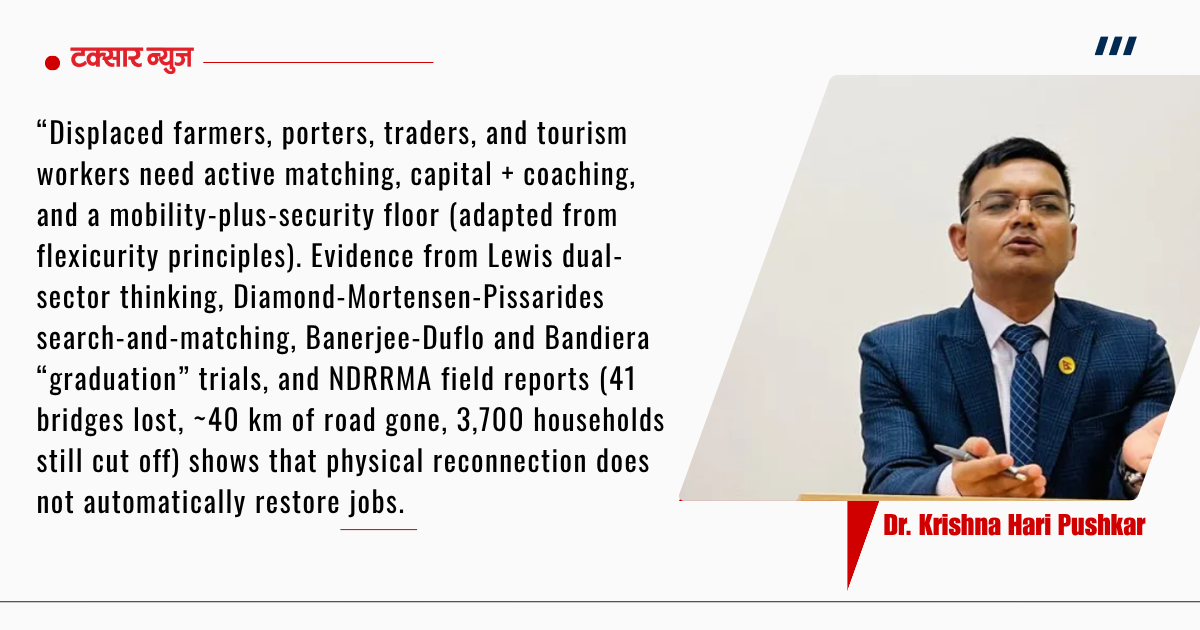
The National Disaster Risk Reduction and Management Authority, NDRRMA, has reported exactly this kind of friction on the ground. Forty-one motorable bridges were washed away and four more damaged. Roughly forty kilometers of road were lost along the corridor. As of early September, some 3,700 households, over 14,000 people, in Rasuwa’s Gosaikunda and Amachhodingmo rural municipalities remained cut off, with road access, electricity, and communication disrupted for days.
This is the direct, physical rationale for building an active, digital job-matching system into this recovery, working alongside the natural process of markets reconnecting as roads reopen.
A well-documented body of evidence speaks to a question donors ask often: does giving displaced households capital and coaching produce durable results? A six-country randomized trial led by Abhijit Banerjee and Esther Duflo, published in Science in 2015, found that a multifaceted package combining a productive asset transfer with temporary consumption support, training, and coaching produced gains in income and consumption that lasted well beyond the program itself.
A related study by Oriana Bandiera and colleagues, published in the Quarterly Journal of Economics in 2017 using data from more than 21,000 households in Bangladesh, found that removing specific barriers, mainly access to capital and skills training, helped poorer households shift into higher-earning work.
Taken together, the studies suggest that well-designed, bundled support addressing multiple barriers at once produces more durable gains than a single form of assistance offered alone.
The fourth strand offers a useful way of thinking about how these pieces fit together operationally. Denmark’s experience with what is known as flexicurity offers a helpful conceptual analogy, combining labor market mobility with income protection and active employment support, rather than treating flexibility and security as opposites.
The lesson for the corridor is not to import the Danish model, its economy, formal labor institutions, and fiscal capacity are quite different from Nepal’s, but to adapt its underlying principle, mobility supported by a credible security floor, to Nepal’s largely informal and mixed-livelihood economy. In practice, this means a worker should be able to move between informal trade, reconstruction work, retraining, and eventual return to farming or tourism as each sector recovers, without losing access to the basic protections and employment services available to them.
Building on What Nepal Already Runs
CALEG’s strongest quality is as much practical as economic: Nepal already has strong institutions well suited to a Laboureconomics approach, several of them already visibly active in this response. It needs them connected around one purpose, not replaced or duplicated.
The precedent is close at hand. Following the 2015 Barpak-Gorkha earthquake, the National Planning Commission, NPC, prepared a Post-Disaster Needs Assessment, or PDNA, that established the financial scale of reconstruction, ahead of an international donor conference and the creation of the National Reconstruction Authority. The government has confirmed it is preparing a fresh PDNA for the Bhotekoshi-Trishuli corridor along similar lines.
NDRRMA’s preliminary estimate puts total loss near Rs 400 billion, while the Finance Minister has separately indicated that reconstruction and rehabilitation needs could fall between four and five billion US dollars, a figure he has been clear will be refined once the full assessment is complete. The Finance Secretary has confirmed that roughly twenty billion rupees was already available for immediate mobilization from the current fiscal year’s budget for rescue, relief, and emergency response. This gives CALEG a real, moving foundation to build on rather than a theoretical one, the institutional sequence that will determine the corridor’s financing envelope is already underway.
On employment specifically, Nepal’s employment architecture has itself just been rebuilt. In January 2026, the government implemented a new directive discontinuing the former Prime Minister Employment Programme, or PMEP, and replacing it with the National Employment Promotion Programme, NEPP, operating across all seven provinces and all 753 local levels, with employment service centers planned in every village and a national steering committee drawing on the Ministry of Finance and the Ministry of Federal Affairs and General Administration alongside the labor ministry.
This gives CALEG a genuinely current channel to work through rather than an outdated one. Its present scale, however, funded this fiscal year to place roughly seventeen thousand people nationally, is modest set against what a single major disaster corridor will require, and would need substantial supplementary resourcing to serve Rasuwa, Nuwakot, and Dhading at the scale this recovery demands.
Alongside NEPP, the Social Security Fund, SSF, whose coverage is now being extended toward informal and self-employed workers under a broader national effort, could provide part of the security foundation for this system, though current coverage of informal workers remains limited and would need meaningful administrative expansion for CALEG to rely on it at scale, an expansion this recovery could itself help accelerate. That continuity, moving between programs without losing ground, is the organizing idea behind CALEG’s borrowing from the flexicurity principle.
The Seven Pillars of Post-Disaster Laboureconomics
Laboureconomics, as applied to disaster recovery, rests on seven operational pillars. Together they turn the underlying principle, that a population’s labor capacity is itself infrastructure, deserving the same deliberate reconstruction as roads and power plants, into a working architecture. Each pillar addresses one dimension of that principle; none stands alone as a separate idea.
Labor Reactivation, the first pillar, connects displaced workers to employers through active matching rather than waiting for markets to reconnect on their own. Enterprise Recovery, the second, treats small shops, lodges, and roadside stalls, the backbone of everyday commerce in places such as Timure, Syabrubesi, and Betrawati, as economic infrastructure worth rebuilding deliberately, on the same footing as physical assets.
Skills Matching, the third pillar, trains people against verified employer demand through the Council for Technical Education and Vocational Training, CTEVT, the National Academy of Vocational Training, NAVT, and other state and non-state accredited training providers, so training leads directly to hiring rather than producing credentials disconnected from work. Social Protection, the fourth, extends coverage toward informal workers, a substantial share of this corridor’s workforce, and forms the security half of the mobility-and-protection balance at the heart of a Laboureconomics response.
Resilient Reconstruction, the fifth pillar, ties every rebuild to a hazard check, so recovery strengthens the corridor’s labor capacity against future risk rather than exposing it again. Financial Resilience, the sixth, draws on NRB’s refinancing tools, its already-active emergency banking measures, and a pilot parametric insurance facility to restore the credit and risk-transfer instruments that let labor capacity translate into earnings. Evidence and Accountability, the seventh and final pillar, tracks what is working, openly, at ward level, and feeds directly into NPC’s PDNA process rather than running as a separate exercise, so the labor dimension of recovery is measured with the same rigor as its physical dimension.
CALEG is the applied instrument built on this seven-pillar foundation, not a separate framework alongside it. Its distinctive contribution is coordinating these seven pillars of post-disaster Laboureconomics around one outcome: restoring and upgrading the productive capacity of affected households while building recovery that reduces, rather than reproduces, future vulnerability.
One governing rule sits above all seven pillars: recover without recreating vulnerability. Reopen quickly where it is safe to do so, and let safety, not simply urgency, set the pace.
Five Tracks Back to Work
The first track is immediate cash-for-work, on debris clearance, trail repair, road repair, and slope stabilization, delivered through NEPP’s local employment service centers, with every project screened for safety before it starts, and with obvious early priority given to the forty-one washed-away bridges and roughly forty kilometers of damaged road along the corridor.
The second is a corridor-wide CALEG Labor Exchange, reachable by mobile phone, text message, and ward-level help desks, effectively a specialized extension of the employment service centers NEPP is already establishing in every village. It would match displaced workers directly with hydropower companies, tourism operators, and reconstruction contractors, the practical machinery that turns the mobility-and-security principle into something workers actually use day to day. Employer registration on the exchange should include basic verification, wage disclosure, and occupational safety requirements, with a clear channel for workers to report non-payment or unsafe conditions, so the platform builds trust from the outset.
The third is demand-driven retraining through CTEVT and other accredited providers, built on a rapid survey of what employers actually need, masons, electricians, solar technicians, site supervisors, geohazard monitoring assistants, so training leads directly to jobs. The fourth is enterprise revival finance staged by need, small restart grants first, working capital next, and growth financing for businesses ready to scale, with private-sector collaboration through bodies such as the Federation of Nepalese Chambers of Commerce and Industry, FNCCI, and the Confederation of Nepalese Industries, CNI.
The fifth is direct support for self-employed shopkeepers and small producers, through subsidized credit lines developed jointly with commercial banks, local cooperatives, and the private sector, so families can reopen a shop or a teashop of their own alongside larger reconstruction efforts.
Getting Each Sector Moving Again
Trade can restart across the whole corridor, not only at the border, through temporary market points wherever settlements were devastated by the disaster, from Timure and the Rasuwagadhi crossing to affected communities elsewhere in Rasuwa, Nuwakot, and Dhading, using simple prefabricated stalls and mobile banking access, coordinated with local government, banking institutions, district administration, and security agencies, with cross-border arrangements handled separately for Kerung, while that permanent infrastructure is rebuilt.
Tourism should reopen on the principle of safety guiding speed, trail segments and bridges certified one at a time, coordinated with the Trekking Agencies Association of Nepal, TAAN, given that parts of the Langtang area remained cut off after roads and bridges were damaged.
Hydropower restarts should follow a weighted decision matrix, factoring in geotechnical stability, worker and public safety, grid importance, repair cost, employment impact, insurance status, time to restart, and future hazard exposure, worked out together with the Nepal Electricity Authority, NEA, and affected developers.
Agriculture should move toward genuine livelihood diversification, guided by soil and slope assessment on each affected terrace, so each plot above the Bhotekoshi-Trishuli returns to whatever use suits it best going forward.
Protecting Households Through the Gap Years
A dependable social security system gives households the confidence to invest in rebuilding here at home. SSF and its Contribution-Based Social Security Programme, alongside Nepal’s pension and insurance institutions, whose combined framework is being actively expanded to reach informal and self-employed workers, could extend temporary priority attention to workers whose employers were affected, building on that expansion effort.
For the corridor’s substantial informal and mixed-livelihood workforce, and for the many workers, traders, and visitors from elsewhere in Nepal and abroad who happened to be living, working, or doing business there when disaster struck, CALEG proposes a time-bound Disaster Social Protection Card, understood clearly as a new, temporary mechanism. It would function as a coordination layer through which qualified households and affected individuals could access, subject to program design and available financing, health support, education assistance, and priority access to the job programs above, with a straightforward appeals process for anyone initially missed.
Local cooperatives, important financial institutions in many rural communities, could be recapitalized with matching funds, supported by clear governance and fiduciary safeguards, so they can extend emergency loans confidently even if demand rises quickly.
A parametric insurance pilot for hydropower and tourism assets, led by the Ministry of Finance and jointly supported and administered by the Insurance Authority of Nepal, Nepal Rastra Bank, and other relevant regulatory and development partners, could begin with a limited set of clearly defined assets and hazard perils, triggering payouts automatically once agreed thresholds for river level or seismic activity are crossed. Such a pilot would function as a valuable complement to conventional damage assessment, not a substitute for it, as the mechanism is tested, refined, and scaled with experience.
An Indicative Three-Phase Sequence
Stabilize, during approximately the first ninety days, means registration, emergency cash-for-work, and restoring basic market access and communication, particularly for the households still cut off in Gosaikunda, Amachhodingmo, and other areas. This work is already partly underway through the roughly twenty billion rupees the Ministry of Finance has confirmed is immediately available from the current budget.
Reactivate, over the following three to twelve months, means the labor exchange goes live, enterprise grants start flowing, and sectors reopen in phases. This is where displaced workers move between cash-for-work, short courses, and reopening businesses while keeping their footing throughout.
Transform, across the twelve to thirty-six months after that, means higher-productivity jobs take hold, infrastructure is rebuilt with resilience in mind, insurance is in place, and the corridor is left with labor market institutions that serve it well beyond this one recovery.
These timeframes are indicative rather than fixed, ground conditions in a Himalayan corridor will rightly shape the actual pace.
Who Pays, and How Progress Gets Measured
Financing should draw jointly on the Government of Nepal, Bagmati Province, the affected local governments, development partners, climate and loss-and-damage finance windows, and private co-investment, sharing the responsibility broadly. The scale of that financing is already coming into focus, NDRRMA’s preliminary loss estimate near Rs 400 billion and the Finance Ministry’s preliminary four to five billion dollar reconstruction estimate will both be refined by the forthcoming PDNA, following the same institutional practice used after the 2015 earthquake. CALEG’s Laboureconomics components should be built into that assessment from the outset rather than added afterward as a separate ask.
From the start, CALEG should be built to measure its own results clearly, with a handful of headline indicators: the share of affected working-age adults back in employment, median earnings recovery, the pace of return to productive work over three, six, and twelve months, enterprise survival after a year, the share of trainees placed in jobs, and the share of reconstruction spending reaching local firms and workers. Baseline household surveys, collected early, and a running panel of the same households over time, would let government and partners see, with real numbers, whether displaced workers are finding steadier and better-paid work.
Because CALEG brings together worker registration, cash transfers, training, enterprise finance, and procurement, building trust from the outset matters, including around who is selected for jobs, grants, training, and contracts. Treating beneficiary and contractor selection as a governance question, not only an administrative one, alongside transparent eligibility criteria, accessible grievance channels, and openly published program data, would give government, donors, and communities shared confidence that the program is reaching those it is meant for, and would guard against the kind of relief-fund fraud NRB has already had to publicly warn the public about in this very disaster.
What Each Partner Owes the Recovery
Government’s role is to coordinate across levels and disclose spending openly, working through the Ministry of Finance, NPC, NDRRMA, the Ministry of Youth, Labour and Employment, and the relevant provincial and local bodies on the employment and social protection elements described here.
Local governments, closest to the affected wards, are best placed to register workers, monitor projects, and handle grievances quickly. Development partners can finance and provide technical assistance while aligning behind one shared framework, working together rather than in parallel. The private sector, hydropower and tourism firms especially, can provide jobs, reopen supply chains, and co-invest in training. And the communities of Rasuwa, Nuwakot, and Dhading hold the most important role of all, helping design the program and identifying, early and openly, where more support is needed.
Throughout, CALEG’s aim is to reduce distress-driven migration while fully respecting people’s freedom to migrate when that is their preferred path, recovery succeeds when people have real choices, not when everyone stays in place by necessity.
The Bottom Line
Nepal does not need to invent a new institution to make this recovery work. It needs the ones it already has, and several of them, the Ministry of Finance, NPC, NDRRMA, NRB, the newly restructured NEPP, are already moving or already rebuilt for exactly this purpose.
This program, alongside CTEVT, NAVT, SSF, and Nepal’s digital financial infrastructure, now needs to be connected around a single goal: turning reconstruction into a lasting investment in the productive capacity of the corridor’s severely affected population and residents, including the Tamang, Hyolmo, and other communities who call this corridor home. A flexicurity-inspired approach, adapted rather than imported, gives that effort its operating logic, letting workers move across a changing local economy while a credible floor of income protection, employment services, and retraining travels with them wherever they go.
Every major infrastructure investment in this corridor should carry with it an explicit, accountable commitment to the workers, enterprises, and communities whose livelihoods depend on it, not as an afterthought to reconstruction, but as its equal and inseparable purpose. This is what CALEG is built to deliver: a working application of Laboureconomics, drawn from years of practitioner experience rather than academic exercise, costed alongside NPC’s own needs assessment, measured against real outcomes, adapted to the institutions Nepal already has, and set in motion as conditions on the ground allow. Should the Bhotekoshi-Trishuli corridor’s recovery succeed on these terms, it will demonstrate something larger than any single reconstruction effort: that in the aftermath of disaster, a people’s labor, properly recognized and rebuilt, is infrastructure in its own right, and that Laboureconomics, first tested here, deserves a lasting place in how nations everywhere choose to answer catastrophe.