

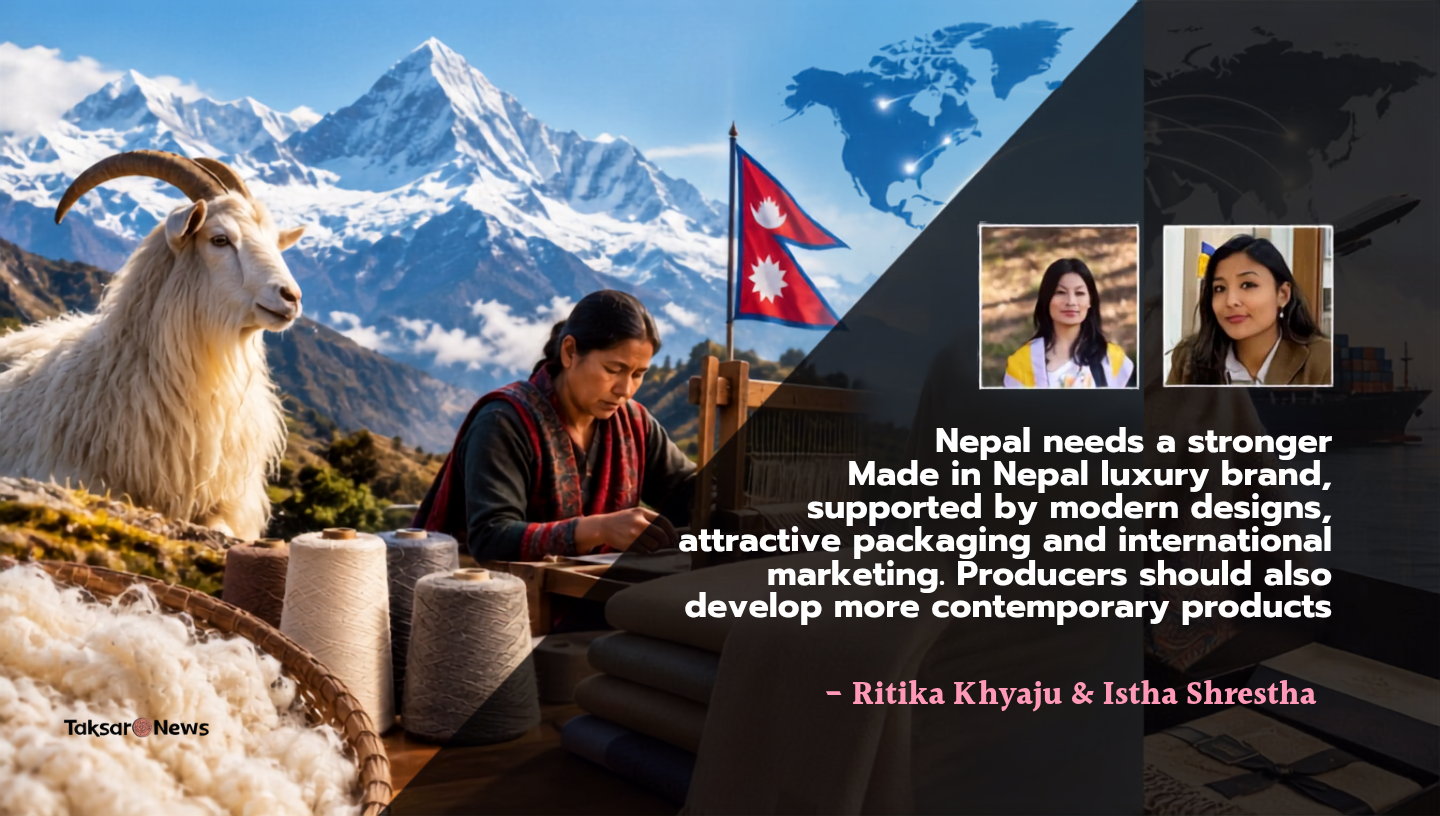
By Ritika Khyaju and Istha Shrestha____
However, Nepal’s pashmina industry faces several challenges. One major issue is the supply of raw materials. According to TEPC, Nepali pashmina industries import pashmina and silk yarn mainly from China and India. This means that an important part of the production process takes place outside Nepal, making it more difficult to build a fully traceable “Made in Nepal” luxury product. The industry also needs improvements in productivity, quality, market linkages and value-chain development.
Chyangra Pashmina is one of Nepal’s important high-value export products. It is made from the fine inner wool of the Himalayan goat, locally known as Chyangra. Pashmina represents Nepal’s natural beauty and traditional craftsmanship. According to the Trade and Export Promotion Centre (TEPC), Nepali pashmina products are exported to more than 40 international markets, including the United States, Italy, Canada, the United Kingdom, France, Japan, Germany and India.
To address these issues, the Government of Nepal launched the National Pashmina Sector Export Strategy 2022–2026. The strategy aims to increase Chyangra Pashmina exports to US$75 million by 2026. In 2021, Nepal exported pashmina shawls worth Rs. 2.53 billion (US$19.31 million).
Nepal also faces strong competition from other countries. India has a well-established pashmina industry and has developed a Pashmina Certification Centre through the Export Promotion Council for Handicrafts (EPCH) and the Wildlife Institute of India.
Nepal also faces strong competition from other countries. India has a well-established pashmina industry and has developed a Pashmina Certification Centre through the Export Promotion Council for Handicrafts (EPCH) and the Wildlife Institute of India. The centre tests pashmina products and provides authenticity certificates. Its testing facilities were also upgraded with advanced equipment in 2024.
Pakistan has a large textile and apparel industry. According to its Ministry of Commerce, textiles and apparel contributed around 60% of Pakistan’s total exports, and the country is focusing on improving quality, increasing value addition, diversifying markets and strengthening international competitiveness. Afghanistan also considers cashmere an export-potential sector and emphasizes increasing value addition within the country.
Because of this competition, Nepal should not try to compete mainly through low prices or large-scale production. Instead, it should focus on its unique strengths: authenticity, Himalayan origin, traditional craftsmanship and luxury quality.
Nepal should develop a strong Chyangra Pashmina certification and traceability system so customers can verify where a product comes from and whether it is genuine. India’s certification system shows how quality verification can increase consumer trust.
First, Nepal should improve its supply chain by supporting Chyangra farmers, increasing local fibre collection and processing, and connecting farmers with manufacturers. Second, Nepal should develop a strong Chyangra Pashmina certification and traceability system so customers can verify where a product comes from and whether it is genuine. India’s certification system shows how quality verification can increase consumer trust.
Third, Nepal needs a stronger “Made in Nepal” luxury brand, supported by modern designs, attractive packaging and international marketing. Producers should also develop more contemporary products instead of relying mainly on traditional shawls and scarves. Finally, digital marketing, international exhibitions and partnerships with international designers can help Nepali producers reach more high-value customers.
Nepal already has some important foundations for rebuilding its pashmina industry. It has an established international market and a national export strategy. The government strategy focuses on increasing supply capacity, improving the value chain and connecting Nepali producers with international markets. The main challenge now is effective implementation of these plans.
Chyangra Pashmina can regain a stronger position in the global luxury market, but branding alone is not enough. Nepal needs to combine genuine local fibre, high quality, traceability, modern designs and effective international marketing.
In conclusion, Chyangra Pashmina can regain a stronger position in the global luxury market, but branding alone is not enough. Nepal needs to combine genuine local fibre, high quality, traceability, modern designs and effective international marketing. Instead of competing with India, Pakistan and Afghanistan mainly on price, Nepal should compete through what makes its pashmina distinctive: its Himalayan origin, genuine Chyangra fibre and Nepali craftsmanship.

References
European Union Delegation to Nepal. (2023). Nepal launches National Pashmina Sector Export Strategy to increase exports to USD 75 million by 2026.* European External Action Service.
Export Promotion Council for Handicrafts. (2024). Pashmina Certification Centre. Government of India.
Ministry of Commerce, Government of Pakistan. (2022). Textiles and Apparel Policy 2020–2025. Government of Pakistan.
Ministry of Industry and Commerce, Government of Afghanistan. (2019). Afghanistan National Trade Policy. Government of Afghanistan.
Trade and Export Promotion Centre. (n.d.). Pashmina Products. Government of Nepal.