

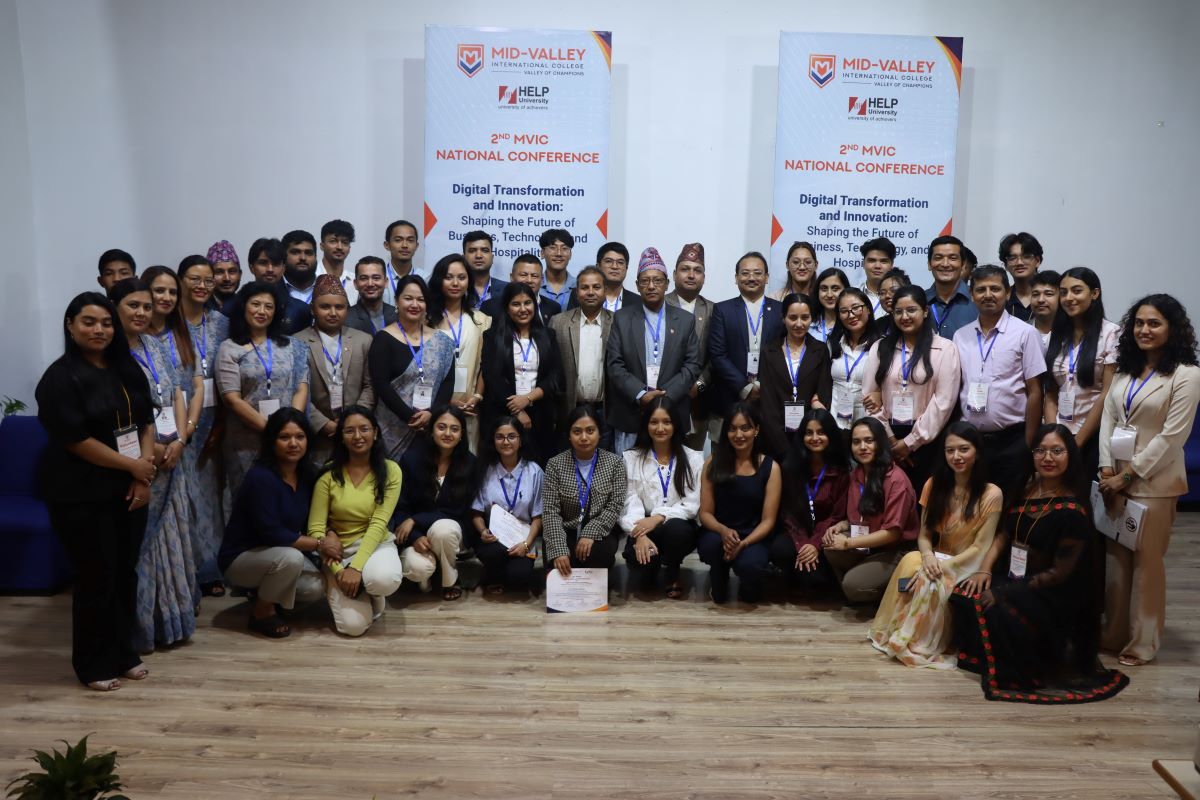
Kathmandu: Speakers at the second National Conference organized by Mid-Valley International College have emphasized the need to translate research and technological advancements into practical applications to drive transformation in business, technology and hospitality.
The one-day conference was organized under the theme “Digital Transformation and Innovation: Shaping the Future of Business, Technology and Hospitality.” Discussions at the event focused on research, emerging technologies, artificial intelligence (AI), tourism, digital financial services, hospitality and their broader impacts on society and the economy.
Speaking at the event, Mid-Valley International College Chairperson Rital Rana said research has been creating new opportunities for knowledge, technology and innovation.
Noting the rapid development of various technologies around the world, Rana stressed the importance of using them appropriately and according to actual needs.
She said researchers should not limit their work to preparing research papers and keeping their findings on paper.
“Research should not be limited to conducting studies and preparing research papers. The findings should be applied by identifying the sectors where they are needed.”
According to Rana, research can contribute to solving social problems and supporting national development when its findings are connected with practical applications.
She also praised the research initiatives being undertaken by Mid-Valley International College and said future research conducted by the institution should focus on areas that can be utilized in different sectors of the country.
Rana encouraged students and researchers to explore new areas of study and emphasized the need to institutionalize research and innovation.
Similarly, Mid-Valley’s Head of Research Dr. Padam Dangol said conferences of this nature help create an important environment for the development of new technologies and research.
He said research conducted today could contribute to the development of new knowledge, technologies and solutions in the future.
Dangol described the conference as more than a platform for researchers to present their findings, saying it also provides an opportunity to learn from one another, exchange ideas and establish a foundation for future research.
“The results of research conducted today will be useful in developing something new in the future.”
He said research helps students develop new ideas while strengthening their confidence and capabilities.
According to Dangol, such events not only provide students with opportunities to present their research but also encourage them to develop an interest in exploring and studying new subjects.
He stressed that research should be connected not only with students’ academic pursuits but also with the needs of society and the state.
“Such programs develop students’ confidence and capabilities. Their impact is not limited to students but can extend to society and various sectors of the state.”
Dangol also announced that Mid-Valley International College is preparing to expand its annual conference from a national-level event to an international conference next year. The college plans to broaden the event by inviting researchers, experts and academics from Nepal and abroad.
He further said the research papers presented at the conference would be published as articles in the coming months, providing researchers with an opportunity to present their work in a more systematic and wider manner.
Meanwhile, Tribhuvan University Professor Dr. Satish Kumar Ojha said technology has passed through several stages of development and is now advancing at an unprecedented pace.
He said technological advancement has significantly changed the way people work, operate businesses and deliver services.
Ojha stressed that the use of new technologies has become essential for sustainable development. Technology, he said, should not merely be viewed as a symbol of modernity but as a tool for increasing productivity, improving services and making people’s lives easier.
Highlighting the rapid development of artificial intelligence, Ojha urged students and researchers to learn how to use AI responsibly and effectively.
He said AI could be utilized across various sectors, including business, education and tourism, and emphasized the need to develop the skills required to understand and use emerging technologies.
Ojha also encouraged students not to be afraid of failure while pursuing new ideas and initiatives.
“Everything does not have to be right from the beginning. We learn as we continue, and we can achieve better results through that process.”
Addressing growing concerns that rapid advances in AI could eliminate human jobs, Ojha said there was no need for unnecessary fear.
He argued that AI was more likely to assist people in making their work easier and more efficient than completely replacing them.
He noted that professions such as nursing, teaching, counselling and travel-related services require human emotions, experience and direct interaction, making it difficult for AI to completely replace such roles.
AI, he said, should be viewed as a supportive technology rather than a competitor to humans.
The conference also featured a presentation by Acharya Shri Mahendra Vashistha on “Interrelationship Between Spiritual Journey and Scientific Research.”
Vashistha discussed the relationship between scientific research and spiritual development, highlighting the growing levels of mental stress and imbalance in modern society.
He said practices such as meditation and mindfulness could help people maintain mental peace and develop a more positive outlook.
He emphasized the need to face life’s problems and challenges calmly and argued that spiritual practices can play an important role in maintaining inner peace.
According to Vashistha, while technology has made people’s external lives easier, personal discipline, meditation and positive thinking remain important for maintaining inner peace.
He said achieving a balance between modern technology and spiritual awareness is essential for the overall development of individuals.
Researchers at the conference presented papers covering a wide range of areas, including business, technology, tourism, environment, digital financial services, healthcare, transportation and hospitality.
Among the research topics presented were “Impact of Artificial Intelligence on Tourism Industry of Pokhara Valley,” “Geospatial Analysis of Urban Green Space Dynamics in the Kathmandu Ring Road Area: A Multitemporal Remote Sensing and GIS Approach (2015–2025),” “Random Forest Detection of Lake Surface Water Temperature Proxy Anomalies at Lima Lake, Nepal,” “Sustainable Tourism in Nepal: Opportunities, Challenges and Policy Recommendations,” and “Determinants of IPO Participation Among University Students in Kathmandu.”
Additional research papers examined electric vehicle batteries, digital payment services, digital financial services, public transportation, digital wallets, digital literacy, insurtech, machine learning, health records management, digital health, information security and privacy, corporate governance and digital entrepreneurship.
According to the organizers, the conference provided an opportunity for students, professors, researchers and stakeholders from the technology and business sectors to exchange knowledge and experiences on emerging technologies, research and innovation.
The conference concluded with a broader call for stronger collaboration between academic research, technological innovation and practical applications to support Nepal’s future development.