

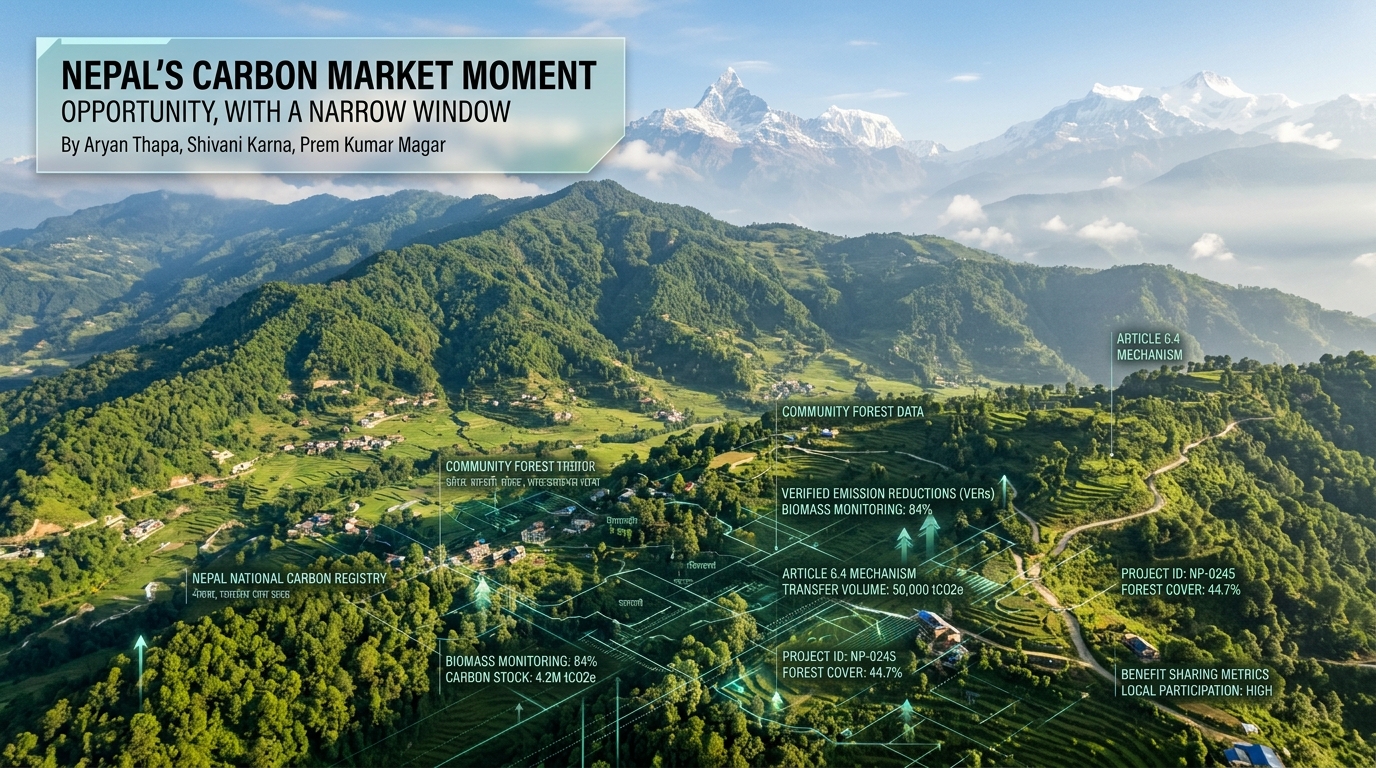
By Aryan Thapa, Shivani Karna, Prem Kumar Magar___
Nepal is preparing to graduate from the world’s least-developed-country category in November. It is also trying to enter a carbon market that could bring foreign investment, climate finance and new export revenue. The timing matters.
Nepal has forests, renewable energy, community forestry experience and a growing carbon-market framework. What it does not yet have is the institutional speed to turn those advantages into a functioning international market.
That gap is becoming more important as the deadline approaches. Nepal is scheduled to graduate from LDC status on November 24, 2026. The government has requested a three-year postponement, and the UN Committee for Development Policy has recommended that an extension be considered, but a final decision by the General Assembly is still pending.
For Nepal’s carbon market, this is more than a diplomatic timetable. The country’s LDC status currently provides automatic additionality for eligible carbon projects, reducing some of the evidence and procedural requirements developers would otherwise face.
For Nepal’s carbon market, this is more than a diplomatic timetable. The country’s LDC status currently provides automatic additionality for eligible carbon projects, reducing some of the evidence and procedural requirements developers would otherwise face.
The Kathmandu Post has reported that this advantage is due to change with graduation and that the government has sought an extension. Whether graduation occurs in November or is postponed, the underlying problem remains. Nepal needs a carbon-market system that can attract buyers and developers without depending indefinitely on a temporary LDC advantage.
Nepal has already built some of the infrastructure needed to make that transition. The government has published a Carbon Trading Regulation, and in 2026 it launched a National Carbon Registry designed to track carbon-market transactions and internationally transferred mitigation outcomes.
UNDP has described the registry as a key part of the country’s carbon-market architecture. Nepal has also amended its environmental regulations to participate in Article 6 of the Paris Agreement, creating a framework for internationally transferred emission reductions.
The country has also secured a significant early transaction. In January 2026, Nepal signed an Emissions Reductions Purchase Agreement with the LEAF Coalition, potentially unlocking up to $55 million in results-based climate finance for forest conservation.

The agreement gives Nepal something more valuable than another policy announcement: evidence that international buyers are willing to engage with the country. But one transaction is not yet a market. That distinction matters.
Nepal has generated carbon revenue before. Projects under the Clean Development Mechanism and other mechanisms have produced millions of tones of verified emission reductions, with reported revenue of roughly $35 million. That is a meaningful track record, but it is small compared with the scale of the global opportunity being discussed.
Nepal has generated carbon revenue before. Projects under the Clean Development Mechanism and other mechanisms have produced millions of tones of verified emission reductions, with reported revenue of roughly $35 million. That is a meaningful track record, but it is small compared with the scale of the global opportunity being discussed.
Kathmandu Post analysis has projected that demand for Article 6 credits could reach roughly $100 billion by 2030. The gap between those two numbers should be treated as an opportunity, not as a guarantee that Nepal will capture a meaningful share of it.
The first obstacle is the private sector. Nepal’s new carbon-trading framework allows foreign investors to participate through joint ventures with Nepal-registered companies, but carbon trading and carbon-project development do not yet have a sufficiently clear place within the country’s investment-approval system.
The result is uncertainty over how projects should be approved, developed and financed. For investors comparing Nepal with other emerging carbon markets, uncertainty itself is a cost.
Ghana offers a useful comparison, not because its experience can simply be copied, but because it shows what institutional preparation can accomplish. Ghana established a Carbon Market Office within its Environmental Protection Agency and developed a carbon registry and Article 6 accounting framework.

Its official reporting identified a pipeline of 35 Article 6 activities across areas including clean cooking, solar energy, transport, agriculture and nature-based solutions. Ghana also signed a bilateral agreement with Switzerland and subsequently became one of the few countries to complete an actual Article 6 transfer.
Nepal has not yet reached that stage. Its regulatory framework is developing, but formal government-to-government carbon transactions remain limited.
The World Bank’s 2026 carbon-pricing report makes the broader point: despite a growing number of Article 6 agreements, the number of completed international transfers remains small. It identifies transfers involving Switzerland and Thailand in 2024 and Switzerland and Ghana in 2025 among the relatively limited number of completed transactions.
The World Bank’s 2026 carbon-pricing report makes the broader point: despite a growing number of Article 6 agreements, the number of completed international transfers remains small. It identifies transfers involving Switzerland and Thailand in 2024 and Switzerland and Ghana in 2025 among the relatively limited number of completed transactions. That should make Nepal cautious about treating carbon markets as easy money.
There are genuine risks. Carbon credits must demonstrate environmental integrity, and international buyers increasingly care about monitoring, reporting, verification and the avoidance of double counting. Projects can also create disputes over who owns the credits and who receives the resulting revenue.
Nepal’s community forestry model gives it an advantage in involving local communities, but it also raises the stakes for transparent benefit sharing. If communities do not understand the value being created or do not receive a credible share of the benefits, the market can lose legitimacy even when the underlying projects are environmentally sound.
There is another risk that receives less attention: Nepal could build institutions without generating enough transactions to justify the optimism surrounding the market. The projected global demand for Article 6 credits is enormous, but global demand does not automatically translate into demand for Nepali credits.

Buyers will compare Nepal with countries that offer clearer regulations, faster approvals, credible monitoring systems and established bilateral arrangements. In that competition, Nepal’s forests and hydropower potential are not enough by themselves.
That is why the LDC transition matters so much. If Nepal’s graduation is postponed, the country gains additional time, but not necessarily a solution. If graduation proceeds as scheduled, the pressure arrives sooner. Either way, the policy objective should be the same: build a market that can stand on its own rather than one that depends on temporary advantages.
The practical priorities are therefore straightforward. First, Nepal should establish a dedicated approval category for carbon projects so investors are not forced to navigate an unclear regulatory route. Second, it should strengthen a specialized Carbon Market Office with responsibility for coordinating project approvals, maintaining market information and supporting international negotiations.
Nepal does not need to become a carbon-market giant overnight. It needs to prove that one credible project can become a pipeline of credible projects, that one international transaction can become several, and that foreign buyers can rely on the country’s rules even as its development status changes.
Third, it should prioritize bilateral Article 6 agreements with credible buyers rather than pursuing agreements simply for the sake of increasing their number. Finally, it should strengthen monitoring, reporting and verification systems and establish transparent benefit-sharing rules so that the credits entering international markets are credible and the communities involved can see tangible returns.
Nepal does not need to become a carbon-market giant overnight. It needs to prove that one credible project can become a pipeline of credible projects, that one international transaction can become several, and that foreign buyers can rely on the country’s rules even as its development status changes.
The real test of Nepal’s carbon market will therefore not be the size of the opportunity being advertised. It will be whether the country can turn its first transactions into a system that investors trust, buyers can verify and local communities can benefit from. November 2026 may change the timetable, but it does not change that test.
Sources consulted for this piece
- “The world wants carbon credits. Nepal has them,” Kathmandu Post, June 24, 2026.
- “Nepal’s carbon market potential,” Kathmandu Post, May 20, 2025.
- “Nepal publishes carbon trading framework, opening door to forest-based Article 6 exports,” Carbon Pulse.
- “Nepal launches National Carbon Registry to bridge climate goals and local action,” UNDP Asia-Pacific, 2026.
- “Carbon Trade in Nepal: High Expectations, Limited Progress,” New Spotlight Magazine, June 22, 2026.
- “Nepal advances on carbon trading, but who benefits?” The Farsight Nepal, January 28, 2026.
- “Carbon Financing and Renewable Energy Opportunities in Nepal,” urjakhabar.com.
- Nepal country profile, Article 6 Implementation Partnership.
- LEAF Coalition, forest government and transaction materials.
- World Bank, State and Trends of Carbon Pricing 2026.
- UNFCCC, Ghana’s Article 6 institutional arrangements and reporting.
- United Nations LDC Portal, Nepal graduation status.